The Skeptic’s Setup: Why I Didn’t Believe This Would Matter
I’ve been through enough AI hype cycles to develop a pretty thick filter. Language models that were going to “replace developers.” Code generation tools that would “eliminate debugging.” Each wave arrives with breathless benchmarks and demo videos of toy problems getting solved in seconds. Then you ship it to production, and suddenly you’re spending three hours untangling some plausible-looking nonsense the model confidently hallucinated into your codebase.

When the Anthropic Claude 3.7 Sonnet announcement landed in February 2025, I approached it with the energy of someone reading a cereal box. Extended thinking mode, chain-of-thought reasoning, blah blah blah. But then I looked at the actual mechanics. This wasn’t just another inference optimization. It was something genuinely different.
The Technical Difference That Actually Matters
Here’s what makes Claude 3.7 Sonnet’s approach different from the usual model upgrades. The extended thinking mode is a hybrid system. You make a single API call, and the model can toggle between two states: rapid-fire mode for straightforward questions, and deep reasoning mode for thorny problems. This matters because it means you’re not choosing between speed and thoughtfulness anymore. The model does. It can spend up to 128,000 reasoning tokens, essentially talking to itself and working through logic problems before committing to an answer.
That self-audit layer is the actual innovation here. Before outputting code, the model has already caught some of its own mistakes. Not all of them, obviously. But enough to change the texture of what comes back. I started noticing this almost immediately when I began testing Claude 3.7 Sonnet against production scenarios. Complex SQL refactoring tasks. Tricky async state management problems. Situations where a rushed answer would be confidently wrong.
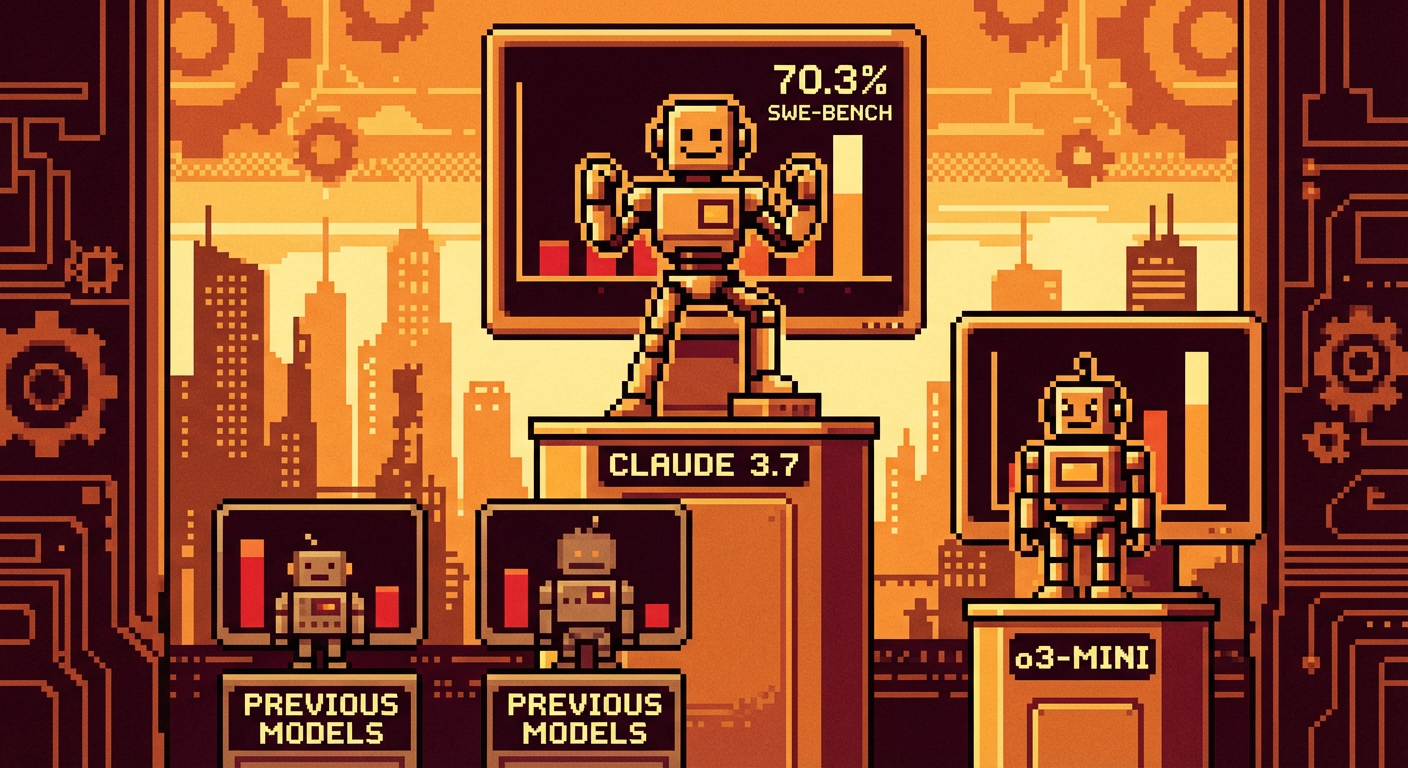
The performance numbers support this. According to the SWE-bench Verified leaderboard, Claude 3.7 Sonnet scored 70.3% on SWE-bench Verified, a significant jump from previous generations that puts it in the same conversation as OpenAI’s o3-mini on coding tasks. But benchmarks measure what they measure. Real production work is messier, more contextual, and deeply specific to your codebase architecture.
Where Extended Thinking Actually Changes My Workflow
I’ve spent the last four months shipping code assisted by Claude 3.7 Sonnet’s extended thinking mode, and the changes are real enough that I’ve updated my development process. The biggest shift is in code review cycles. I’m now using extended thinking mode to pre-review my own generated code before I even open a pull request. This sounds like an extra step, but it’s actually faster than my old workflow of generating code, looking at it suspiciously, then having to manually trace through the logic myself.
The pattern that’s emerged: I describe the problem clearly, request extended thinking mode, and then actually read the reasoning the model produces before looking at the final output. That reasoning thread is often more valuable than the code itself. It shows me where the model made trade-offs, what constraints it was working within, and what edge cases it considered. When the reasoning is solid but the code implementation seems off, I can give targeted feedback instead of vague “make this better” comments.
Pull request cycles have gotten tighter. Enterprise teams are seeing this at scale. GitHub Copilot’s February 2026 enterprise report documented that AI-assisted PR review cycles dropped average review-to-merge time by 34% across surveyed teams. That’s not because the AI code is always perfect. It’s because both the author and the reviewer are spending less time on obvious mistakes and more time on architectural decisions. The model catches the dumb stuff. The humans catch the consequential stuff.
The Adoption Reality Check
I’m not alone in this shift. Stack Overflow’s 2025 Developer Survey found that 76% of professional developers now use AI coding tools daily, up from 44% just two years prior. That’s not a gradual adoption curve. That’s a fundamental change in how work gets done. But here’s where I get skeptical of the narrative again: adoption doesn’t equal effectiveness. Lots of professionals use these tools poorly. They take whatever the model spits out, ship it, and hope for the best. That’s still happening everywhere.
The difference with extended thinking mode is that it makes good practices easier. It rewards you for actually reading what the model produces. The self-reasoning layer means there’s more value in that reading. You get more insight into why the model made certain decisions, and that feedback loop actually changes behavior over time.
What Still Doesn’t Work, and Why That Matters
Let me be clear about the limitations. Extended thinking mode is not a replacement for thinking. It’s a complement to it. The model still struggles with deeply novel architectures it hasn’t seen in its training data. It still makes probabilistic guesses about system design that might look reasonable but fall apart under load testing. It still sometimes generates code that’s technically correct but fundamentally misaligned with your team’s existing patterns.
What extended thinking mode does really well is handle well-defined problems at scale. Refactoring. Bug fixing with clear reproduction steps. Test writing. Performance optimization where the bottleneck is already identified. These are the tasks where reasoning through the problem space actually helps, and these tasks used to eat massive amounts of engineering time. Now they don’t.
The honest assessment: Claude 3.7 Sonnet’s extended thinking mode is legitimately useful for production code, but not in the way the marketing materials suggest. The AI isn’t smarter now, exactly. It’s more thoughtful about showing its work, and that transparency makes it a better tool when you actually engage with it seriously. If you’re using it as a black-box code generator, you’re getting maybe 60% of the value. If you’re actually reading the reasoning and iterating based on what you learn, the number climbs closer to 85-90% for the tasks it’s good at.
That gap between potential and realized value is where the real opportunity lives. The models haven’t changed as much as our workflows need to change around them. If you’re still treating AI coding assistance as a feature you toggle on and ignore, you’re probably not seeing why people are making this shift. But if you’ve started building reasoning into your review process, you might see what I’m seeing. Have you started experimenting with extended thinking modes yet? What’s your actual experience been with the output quality? I’m genuinely curious whether what I’m observing holds up across different codebases and team structures.