The Problem Nobody Wanted to Admit We Still Had
There’s a particular flavor of exhaustion that comes with managing globally distributed applications. You’ve sharded your data, you’ve accepted the CAP theorem, you’ve written enough consistency-handling code to fill a dissertation. Then someone in product asks why you can’t just query across regions without latency penalties. You smile. You nod. You open a pull request that makes you question your life choices.
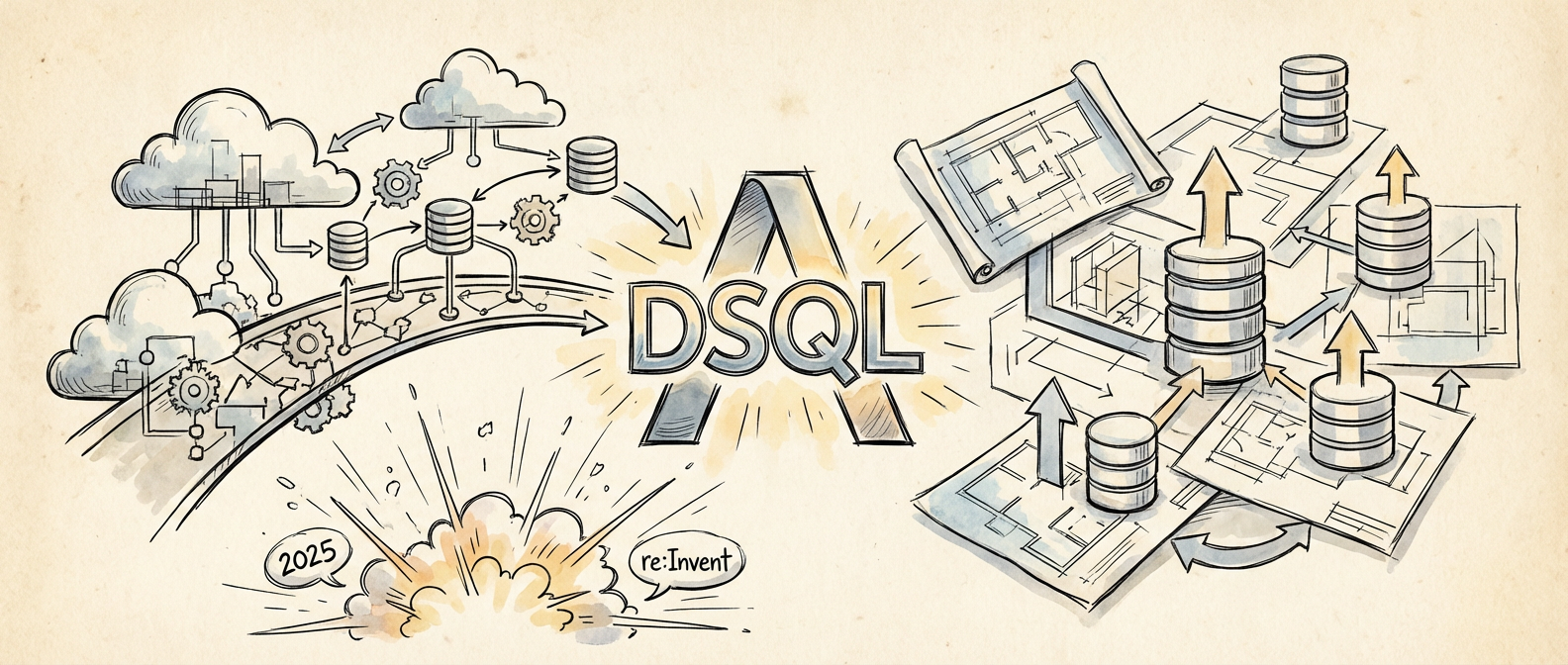
This is the gap that Amazon Aurora DSQL enters. At AWS re:Invent in December 2024, Amazon announced a distributed SQL database that actually handles multi-region writes without requiring you to architect around fundamental limitations. The announcement didn’t get the hype of some other launches. No celebrity keynote. No stadium full of people losing their minds. But if you’ve spent years wrestling with distributed systems, you probably felt something shift.
The core promise is clean: 99.999% multi-region availability with active-active writes. No read replicas masking write locality issues. No eventual consistency surprises at 3 AM. No philosophical debates about whether your data is “consistent enough.” This changes the conversation from “how do we work around distributed SQL limitations” to “why aren’t we using distributed SQL for this.”
The Architecture Decision That Actually Matters
Here’s where Aurora DSQL gets interesting from a technical standpoint. Amazon didn’t follow the traditional path that most distributed databases took. Instead of building on multi-version concurrency control (MVCC) like PostgreSQL or CockroachDB, Aurora DSQL uses optimistic concurrency control paired with an external transaction log separated from storage. This sounds like an implementation detail. It absolutely is not.
Traditional MVCC systems carry overhead because every reader holds metadata about visibility. Every write must consider which versions are visible to which transactions. It works. It’s battle-tested. But it adds weight, especially across regions where network latency makes every round trip matter. Amazon’s approach strips this away. By separating the transaction log from storage, they’ve created a system where writes can commit faster, particularly in cross-region scenarios where latency would normally punish you hardest.
The numbers Amazon quotes suggest up to 40% reduction in write latency for cross-region operations. That’s not a “faster by a few milliseconds” optimization. That’s a fundamental architectural choice paying real dividends. For applications where write performance across regions directly impacts user experience, this matters quite a bit.
The external transaction log deserves particular attention. It’s a deceptively simple idea: keep the source of truth separate from where data lives. This allows regions to operate independently while still maintaining consistency guarantees. Think of it as distributing the heartbeat separate from the organs. It’s an approach that’s worked well in other systems, but seeing it in a managed AWS service means you don’t have to build and operate it yourself.
Pricing and Positioning: AWS Signals Seriousness
By Q1 2026, Aurora DSQL reached general availability across four AWS regions. AWS priced it at $0.50 per DPU-hour, which immediately puts it in direct competition with CockroachDB Dedicated and Google Cloud Spanner. This pricing isn’t arbitrary. It’s a message: we’re not positioning this as a premium alternative. We’re saying we can deliver comparable functionality at comparable cost while keeping you in the AWS ecosystem.
That last part matters more than it initially appears. If you’re already deep in AWS, Aurora DSQL reduces vendor fragmentation. Your backups, monitoring, and operational tooling stay consistent. Your team doesn’t need to learn yet another database system. From a total cost of ownership perspective, that gravitational pull is real.
Google Cloud Spanner, the closest spiritual competitor, offers 99.999% SLA across multi-region setups and reportedly processes over 2 billion requests per second across its entire customer base. That’s scale. That’s proof the architecture works at planetary scale. Aurora DSQL enters this arena leveraging AWS infrastructure and operational expertise to deliver something production-grade from day one.
Market Timing and the Distributed SQL Inflection
Here’s the thing that makes Aurora DSQL’s timing particularly interesting. Gartner’s 2025 Magic Quadrant for Cloud Database Management Systems flagged distributed SQL as the fastest-growing segment, with adoption increasing 38% year-over-year among Fortune 500 companies. That’s not “interesting trend.” That’s an inflection point.
Companies are no longer asking if they should consider distributed SQL. They’re asking which one. They’re evaluating CockroachDB, Spanner, and now Aurora DSQL. The market matured. The use cases solidified. The performance overhead that made distributed SQL a compromise five years ago disappeared. Now it’s a viable architecture choice for mainstream applications, not just greenfield projects built by teams obsessed with elegance.
Aurora DSQL benefits from this timing. It arrives into a market that’s ready to adopt distributed SQL, armed with maturity and AWS credibility. You can check the Amazon Aurora DSQL product page for technical specifications, but the real story is simpler: distributed SQL stopped being exotic. AWS noticed. They built a genuinely competitive offering.
What This Means for Your Architecture, Honestly
Let’s get practical. If you’re currently maintaining sharded databases with cross-shard query complexity, Aurora DSQL warrants serious evaluation. If you’re building applications that need to serve different regions with consistent data and acceptable write latency, this is worth testing. If you’re paying the complexity tax of eventual consistency when strong consistency would actually simplify your codebase, this changes the calculation.
There are situations where Aurora DSQL doesn’t make sense. If your data fits comfortably in a single region, the complexity isn’t justified. If you need specific analytical patterns or real-time OLAP, you’ll still reach for Redshift. If you’ve already optimized around a different distributed SQL solution and it’s working, switching for switching’s sake adds risk.
But for the middle ground where you’re currently uncomfortable with your architecture, where you’re making trade-offs that feel wrong, where you’ve wondered if there was a better way? Now there might be. Check the AWS re:Invent 2024 Aurora DSQL announcement if you want the full technical story from the source.
The quiet bombshell of Aurora DSQL is that it makes a fundamentally difficult problem feel routine. It doesn’t magic away distributed systems complexity entirely. Nothing does. But it removes enough friction that the decision calculus shifts. Sometimes the best innovation isn’t flashy. It’s the kind that makes you realize you’ve been solving a problem the hard way, and now there’s an easier path available.